Security Posture
The Security Posture page reports reachability, RBAC and compliance findings produced by the nightly knowledge-graph scan. Every finding is a graph object — clicking a row opens it in the graph so you can trace the exposure end to end. The header carries Edit dashboard and Export PDF actions.
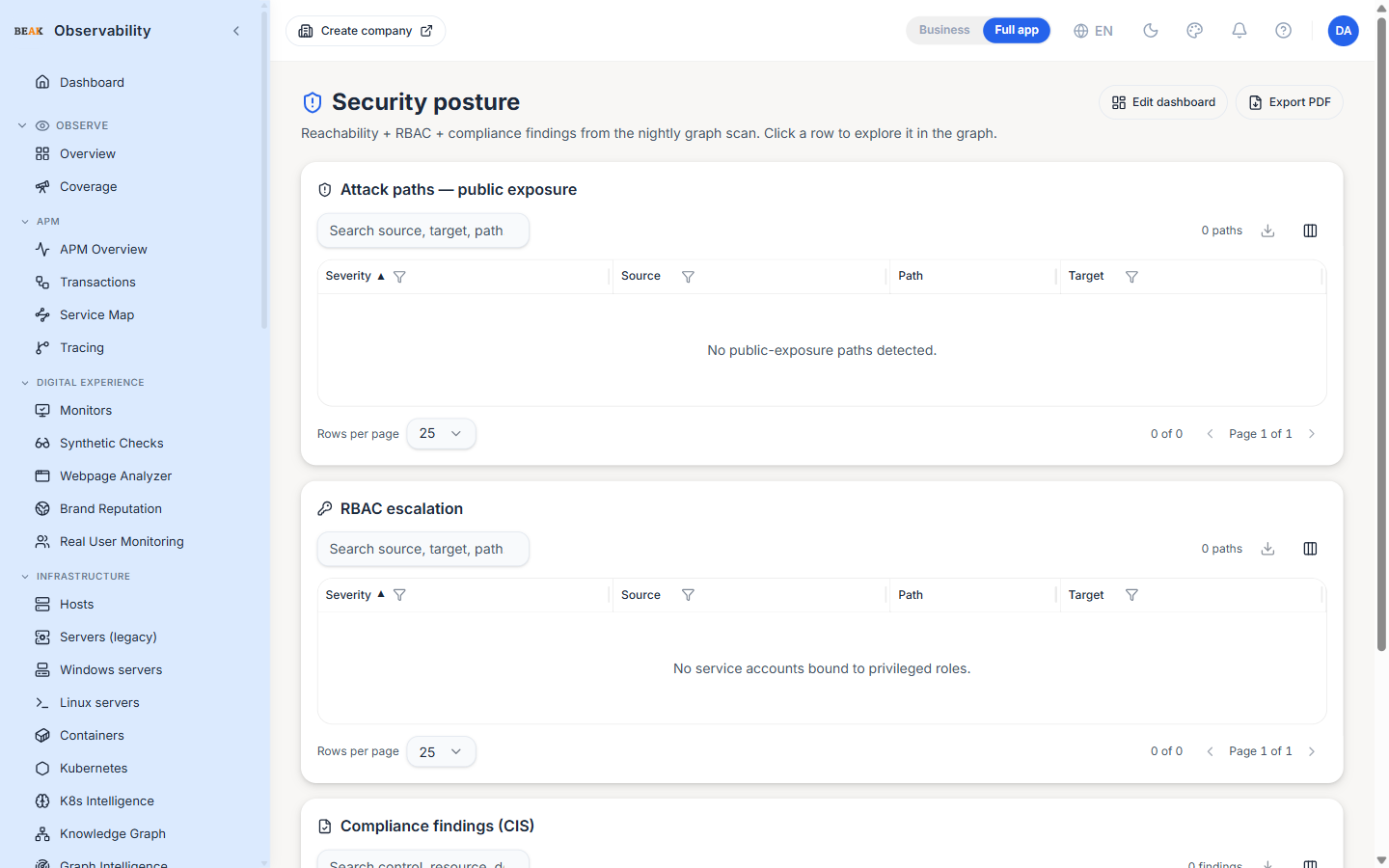
Attack paths — public exposure
Lists the reachable paths from a public entry point to an internal resource. The section header shows the total path count (e.g. 41 paths). Each row is one path:
| Column | Description |
|---|---|
| Severity | Finding severity — e.g. high |
| Source | The public entry point (e.g. an Ingress) |
| Path | The hop-by-hop route through the graph (e.g. Ingress → Namespace) |
| Target | The internal resource the path reaches |
Columns are sortable, so you can lead with the highest-severity exposures.
RBAC escalation
Surfaces role-based-access findings where a subject can reach more privilege than intended — over-broad bindings, or chains that lead to a higher-privilege role. Use it to spot privilege-escalation risk before it's exploited.
Compliance findings (CIS)
Checks the fleet against CIS benchmark controls and lists the controls currently failing, so they can be tracked and remediated against a recognised baseline.
Best Practices
- Triage by severity first — sort the attack-path table and work the
highrows before anything else. - Click through to the graph to confirm a path is genuinely reachable before raising remediation work.
- Findings refresh on the nightly scan — re-check the morning after a change to confirm an exposure actually closed.
Note: This view is also surfaced as the Security posture tab in Predictions & Intelligence and the Security & attack paths card in Graph Intelligence.
Related Pages
- Graph Intelligence — The capability grid this view feeds
- Predictions & Intelligence — Proactive signals, including a posture summary
- Knowledge Graph — The graph the nightly scan walks
- Kubernetes — The cluster resources most paths run through