AI Security Overview
Beak AI Security is an enterprise platform for securing AI agents, LLM deployments, and AI supply chains. It provides layered defenses — from policy enforcement and validator chains to adversarial red teaming and regulatory compliance tracking — all purpose-built for organizations running AI at scale.
What Beak AI Security Covers
Beak AI Security is organized into eight functional areas:
-
Govern — Registered LLM models and their routing, spend and budgets, virtual keys, teams, gateway projects, and budget alerting. This area was previously the separate AI Governance product and is documented under AI Gateway; it is now a section of this console. Governance roles are assigned separately from security roles, and the section is hidden from tenants not entitled to it.
-
Monitor — Track every AI interaction through a tamper-proof audit ledger, drill into individual endpoint DLP incidents, surface Shadow AI usage across the organisation, route flagged events for human review, and replay session chains step-by-step in the Forensic Explorer.
-
Configure — Define the enforcement stack: Validators check individual inputs and outputs, Guardrails group validators into themed safety boundaries, Policies combine guardrails into enforcement rules, the Agent Registry manages cryptographic identities and permission profiles, Devices manages the browser endpoints paired to your tenant, and AI Sites catalogs which AI services the extension detects and their sanctioned status.
-
Supply Chain — Maintain an AI Bill of Materials (AIBOM) for every AI system, tracking models, datasets, dependencies, and CVE exposure across the stack.
-
Security Testing — Run automated adversarial campaigns against your agents with Red Teaming, browse the full MITRE ATLAS technique library to understand coverage gaps, and block an unsafe build from shipping with the CI/CD Security Gate.
-
Runtime Protection — Monitor live threat activity through the Threat Dashboard, with built-in circuit breakers, query throttling, differential privacy, and a vector DB firewall.
-
Reliability — Detect hallucinations in LLM outputs and audit algorithmic fairness across demographic groups before issues reach production.
-
Compliance — Track conformance against the EU AI Act and NIST AI RMF frameworks, with per-article and per-function control scoring and report generation.
Role-Based Dashboards
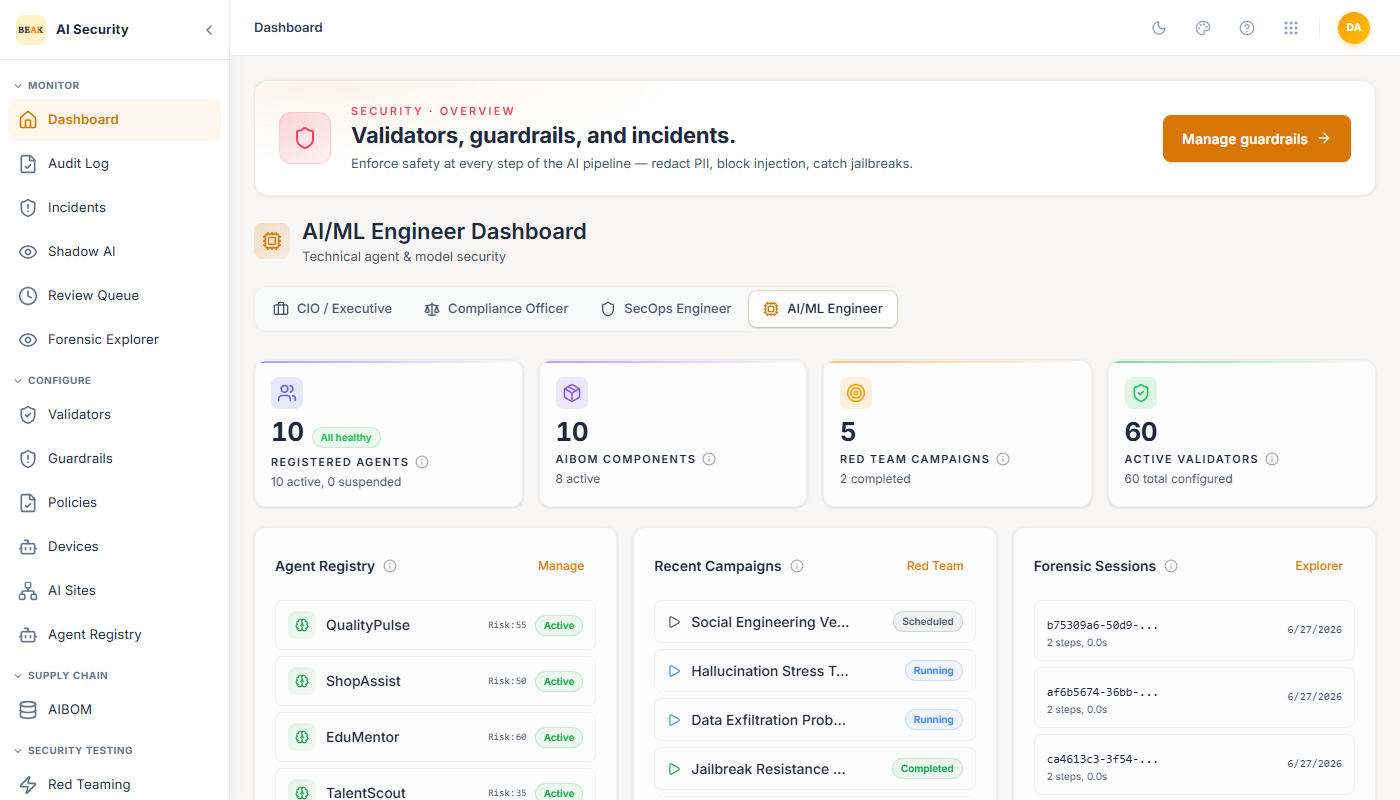
The Dashboard adapts to five personas, each showing the metrics and workflows most relevant to that role:
| Role | Focus |
|---|---|
| CIO / Executive | Security posture score, ATLAS coverage, system integrity, risk overview |
| Compliance Officer | Compliance rate, pending reviews, audit trail integrity, AIBOM inventory |
| SecOps Engineer | Validator counts, active guardrails, review queue, live moderation events |
| AI/ML Engineer | Registered agents, AIBOM components, red team campaigns, forensic sessions |
| Governance | LLM spend and budget health, request volume and success rate, top models by spend, recent requests |
The Governance persona appears only for tenants entitled to AI Governance.
Enforcement Hierarchy
The core enforcement model is a layered stack:
-
Validators — Atomic rules that check a specific condition (e.g., SSRF detection, PII presence, banned topics). Each validator has a type (
security,privacy,reliability,compliance) and returns pass/fail with a reason. -
Guardrails — Named safety boundaries that group related validators. A guardrail such as "Real Estate Compliance" bundles all validators relevant to that domain.
-
Policies — Top-level enforcement objects that combine guardrails and define what happens on a violation:
block_and_audit,log, orflag_and_escalate. -
Agent Registry — Registers each AI agent with its assigned policy, risk threshold, allowed scopes, and optional cryptographic attestation key.
-
Agent Governance — Grants, reviews, and revokes the autonomy that lets an agent run unattended on webhook, mail, and scheduled channels, with an accountable human on every grant.