Assistant vs Orchestrator
Beak AI Studio v6 exposes two agent types, picked at the top of the Create Agent form. The choice determines what the agent can compose and how it executes a turn.
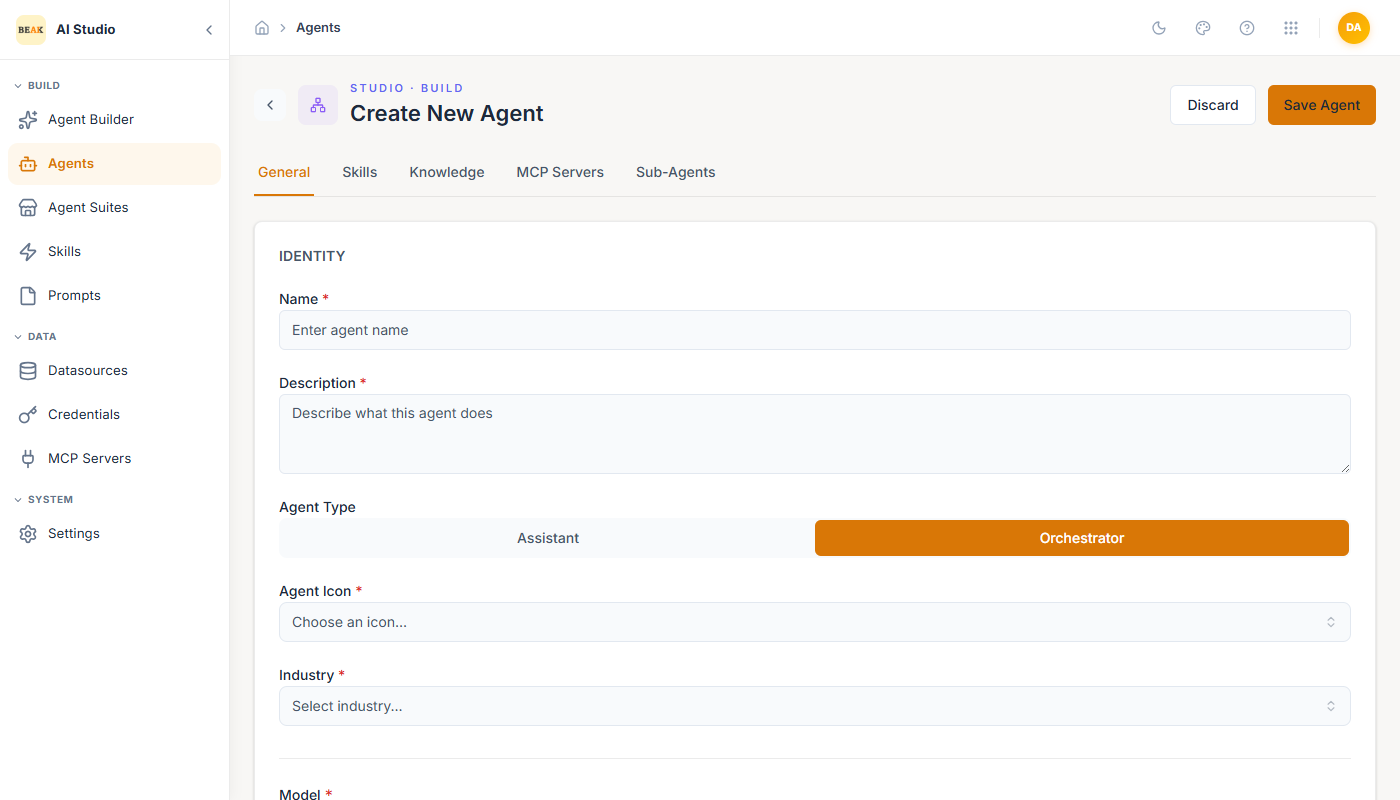
Assistant
An Assistant is a single-purpose agent that handles the full conversation itself. It has its own system prompt, model, skills, datasources, and MCP servers. There is no delegation — every tool call is made by this agent directly.
Use an Assistant when:
- The scope is bounded and self-contained (e.g. claims classification, log triage, lesson-plan generation).
- All required tools and data fit naturally under one persona.
- Conversation memory belongs to a single thread of reasoning.
Most agents in a workspace are Assistants. They are simpler to reason about, easier to test in the Playground, and have lower per-turn latency than Orchestrators.
Orchestrator
An Orchestrator extends an Assistant with a Sub-Agents panel. In addition to its own skills and datasources, it can delegate steps to any other published agent in the workspace. At runtime, the orchestrator's LLM decides per-step whether to invoke its own skill, call a datasource, or hand the step off to a sub-agent.
Use an Orchestrator when:
- A workflow spans multiple domains, each owned by a specialist agent (e.g. quality control orchestrator that delegates SPC analysis to a stats agent and defect classification to a vision agent).
- You want to compose existing agents instead of duplicating their skills into one over-loaded Assistant.
- Different sub-tasks need different models or temperatures.
The Sub-Agents panel only appears when Agent Type is Orchestrator. Sub-agents must be published — drafts are filtered out so an orchestrator cannot reference an unstable dependency.
Choosing Between the Two
| Question | Assistant | Orchestrator |
|---|---|---|
| Single domain, single persona? | Yes | No |
| Reuses other published agents? | No | Yes |
| Needs different models per sub-task? | No | Yes |
| Adds latency from delegation? | No | Yes |
| Easier to debug in the Playground? | Yes | — |
When in doubt, start with an Assistant. Promote it to an Orchestrator only when the system prompt grows large enough that distinct responsibilities are emerging — at that point, split those responsibilities into dedicated Assistants and orchestrate them.